The Hidden Nurse Dictionary

The Lancaster Health and Medical Museum Collection, an affiliated society of BSHM, publishes a short article each month about one of the treasured objects in their collection. Bryan Rhodes describes how one of these objects revealed a hidden book by a remarkable author.

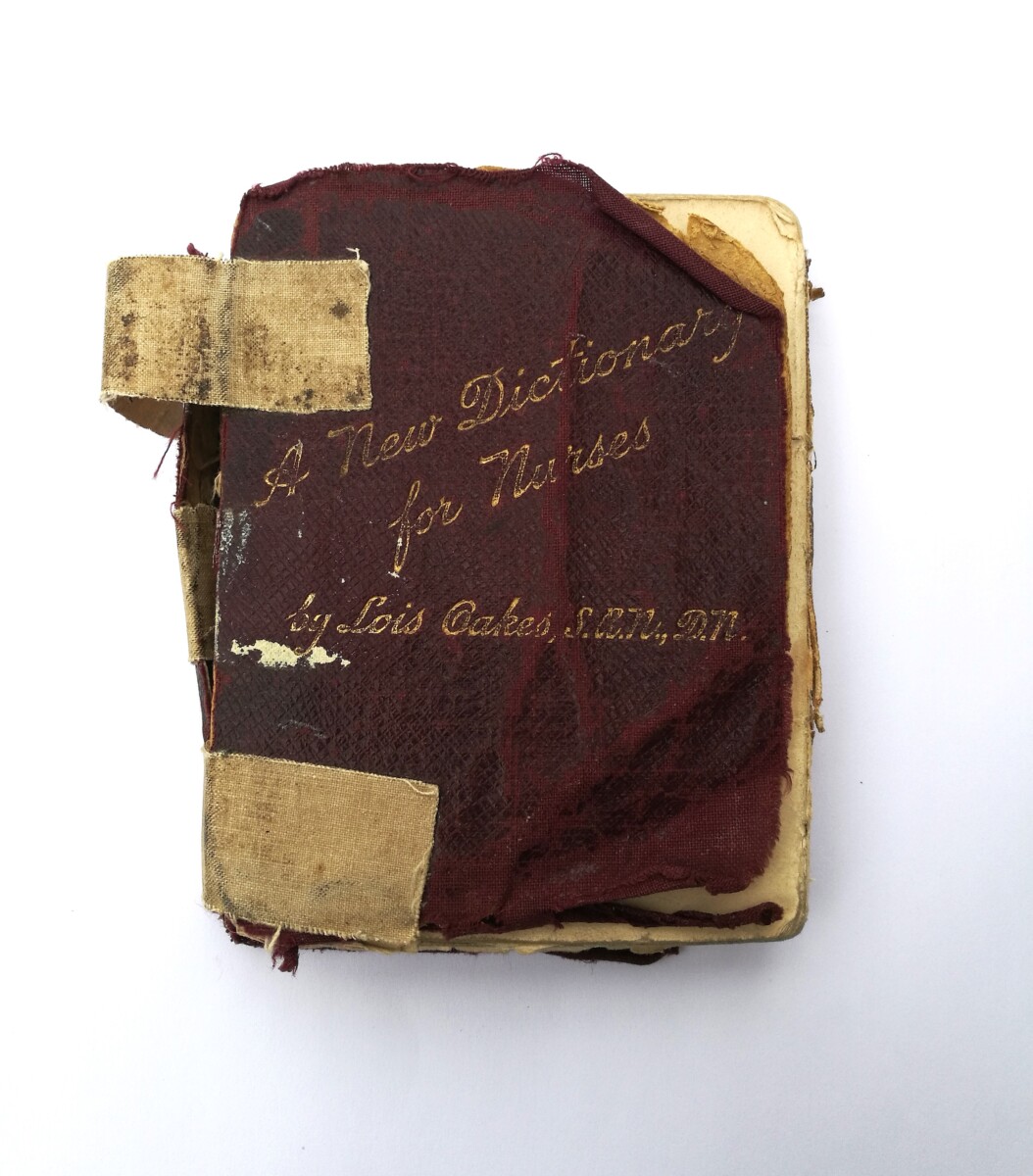
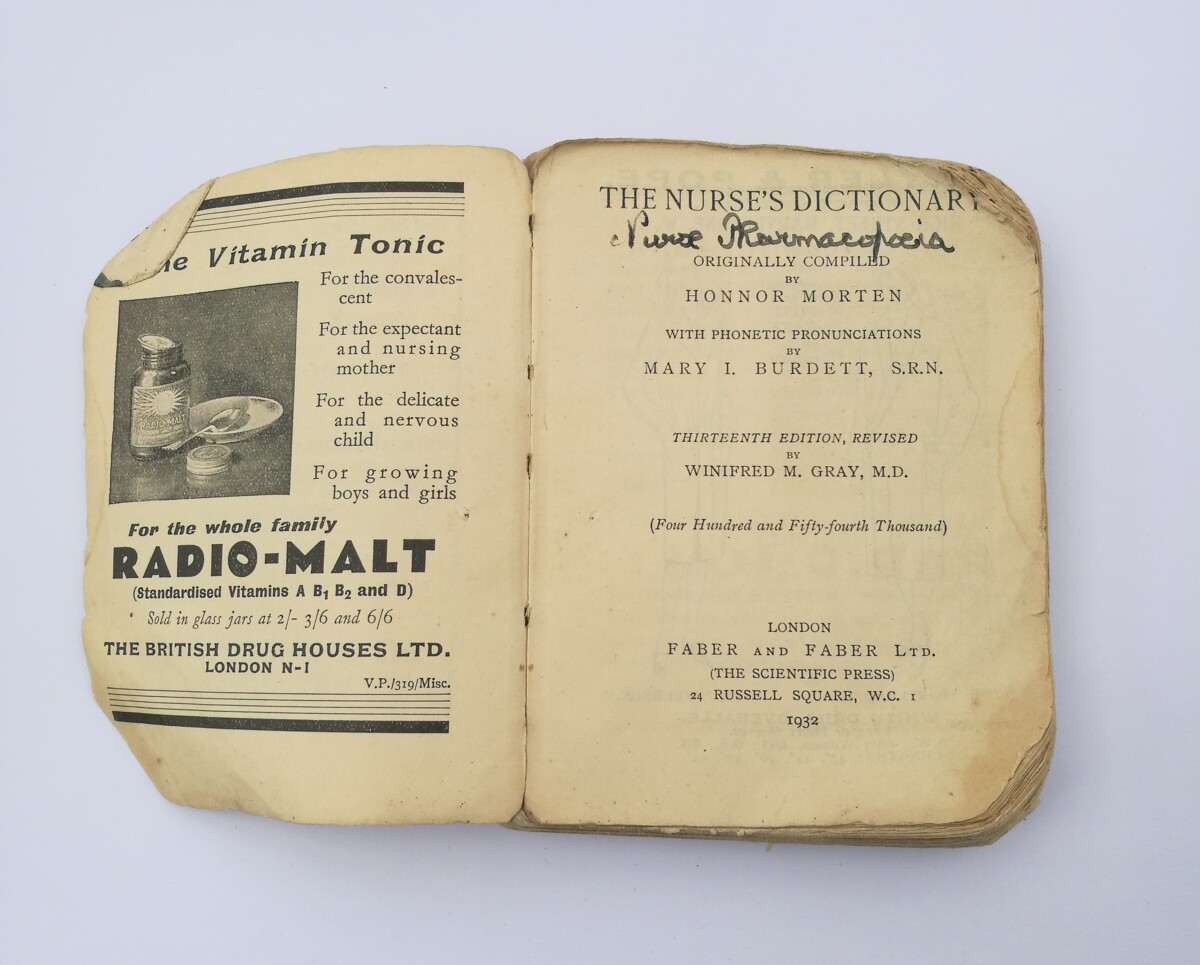
This week marks International Nurses’ Day, and this blog celebrates an interesting nurse dictionary donated to our collection some years ago by an elderly nurse who had trained in Lancaster. Having chosen to feature this book, A New Dictionary for Nurses by Lois Oakes, as our ‘Object of the Month’ for March 2026 on the Lancaster Health and Medical Museum website, I discovered a completely different nurse dictionary hidden inside its damaged cover.

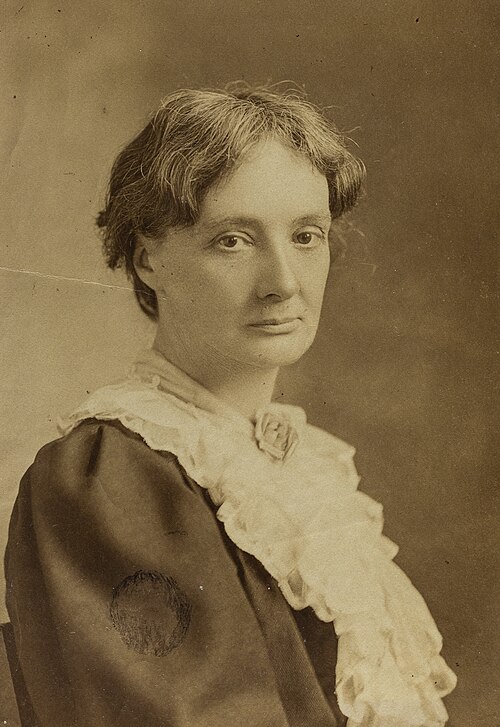
The hidden book’s remarkable author was Violet Honnor Morten (1861 – 1913), who preferred to be known as Honnor Morten. Honnor Morten was not just a nurse and a writer, but also a social activist who lectured widely on family health, women’s rights and nursing care.

A New Dictionary for Nurses by Lois Oakes is small (12 x 9 cm /4.5 x 3.5 inches) and was clearly designed to fit into a pocket. Its well-thumbed and taped cover indicates how much the book was used over the years. The front cover shows that it was first published in 1932. This book, which subsequently became the ‘Churchill Livingstone’s Dictionary of Nursing’, was last published in 2006, the 19th edition.

However, the bulk of the contents, easily separated from the cover, is from another pocket-sized nurse dictionary: The Nurse’s Dictionary by Honner Morten, 13th edition, also published in 1932 by Faber and Faber. In 246 pages, featuring entries from abdomen to zymotic, appears to be a complete Honnor Morten dictionary,

The small photograph found inside the book has the inscription ‘Alder Hey 1932-35’ on the reverse, and the date 1932 is also hand-written inside the red cover.

Honner Morten’s dictionary is almost certainly the most successful nursing publication of all time, achieving 30 editions until the 1980s by Faber and Faber, with three further editions published by Mosby. The final 33rd, edition, entitled Mosby Nurse’s Pocket Dictionary, came out in 2005.

Who was Honnor Morten?

(Violet) Honnor Morten (1861-1913), nurse, author and activist, was born in Surrey and was the daughter of a wealthy solicitor and the niece of a successful author called William Black. She started her nurse training in 1881 at the London Hospital and then studied midwifery before gaining a diploma in scientific hygiene at Bedford College, London. A prolific writer, she contributed articles to The Hospital journal, and the same publisher, Scientific Press, published the first edition of her dictionary in 1891. Then titled Nurse’s Dictionary of Medical Terms and Nursing Treatment, it was the first such dictionary dedicated to nurses. The book went through eight editions in her lifetime and was very successful. This book became The Nurse’s Dictionary, ultimately achieving 33 editions. She also wrote a number of other books between 1888 and 1912, mostly on subjects related to nursing, midwifery or childcare.

Early 20th century white woman with short hair, dark dress elaborate white lace collar

digital.library.lse.ac.uk/

An avowed socialist and non-militant suffragist, Morten lectured widely on family health, women’s rights and nursing care. During the campaign for women’s voting rights, she joined others in refusing to pay taxes, resulting in the confiscation and auctioning of some of her property. She was a founder member of a number of societies including the Women’s Writers Club, the Association of Asylum Workers, the Nurse’s Co-operation and the School Nurses’ Society. The latter was involved in efforts to provide countryside respite care for disabled children, and Morten supported this aim by establishing a centre in Rotherfield, Sussex in 1905 for disabled children from London.

A keen smoker at a time when the health risks of smoking were not understood, she died of throat cancer the year before the first world war began, aged just 52. Her most abiding legacy is the pioneering nurse dictionary which continued to inform nurse trainees more than a century after its first publication.


Bryan Rhodes is the chair of the Lancaster Health and Medical Museum Collection. He is a retired orthopaedic surgeon. He is vice-president of the British Society for the History of Medicine and was guest editor of the 5th edition of the BSHM journal Topics in the History of Medicine.

Further reading:

Ross, E. (2022, May 12). Morten, (Violet) Honnor (1861–1913), nurse and journalist. Oxford Dictionary of National Biography. Retrieved 15 Apr. 2026


Widowhood and Bereavement during and after the English Civil Wars

Recent estimates suggest that more than 3 per cent of the population of England and Wales died as a direct result of the Civil Wars of 1642–1651. Andrew Hopper describes his work on the widowhood and bereavement of the more than 180,000 women who had lost a male relative.

Deaths in Britain and Ireland during their mid-seventeenth-century Civil Wars represent a greater proportional loss of population than Britain suffered during World War One. On a free website, The Civil War Petitions Project publishes details of subsequent petitions to the state from veterans and their families for welfare payments as a result of injuries and bereavement sustained during those wars.

This image shows mounted troops at the Battle of Nasby but also a dead soldier in armour - many men died.

The Battle of Nasby was fought on 14 June 1645 during the First British Civil War. It was an important victory for the Parliamentarians. National Army Museum collection

I am currently analysing the findings of this project for a book that will illuminate the experiences of those bereaved by the civil war, with a particular focus on war widows, orphans and bereaved families, based on the petitions.

This is possible because soon after the outbreak of civil war, Parliament’s ordinance of 24 October 1642 confirmed that not just Parliament’s wounded soldiers, but also the widows and orphans of those who gave their lives for the parliamentary cause would be entitled to apply for monetary relief. A series of further ordinances followed in 1647 that prompted women to petition for state pensions in their thousands.

Securing such provision became more difficult after the Restoration in 1660 when most royalist war widows who were granted relief received one-off gratuities rather than regular pensions. The right to state pensions for all British war widows was not restored until 1901. The records of the 1640s and 1650s therefore represent a unique opportunity to investigate attitudes towards war-related welfare at a time when at least some within the governing regimes considered such women to be part of the political nation.

A first national study

This will be the first national study of seventeenth-century military welfare, drawing on the project team’s research conducted in nearly all the county record offices in England and Wales. It will measure the success of women, children and families in obtaining relief and subsisting compared with that of their fellow petitioners among wounded servicemen.

The book will begin with a social profile of civil-war widowhood and then develop into a wider cultural history of widowhood and bereavement. It will compare the variety of experiences of the war widows of the middling and poorer sorts such as Elizabeth Alkin, nicknamed ‘Parliament Joan’, with those of much higher social status such as Katherine, Lady Brooke.

I will also examine how war widows remembered the conflict, and how this may have differed from more ‘official’ or state-sanctioned memories found in proclamations, thanksgivings, sermons and anniversaries. By looking beyond 1660 and embracing the twin themes of welfare and memory, the book will show how the consequences of the Civil Wars persisted for generations after armed hostilities had come to an end.

Andrew Hopper Professor of Local and Social History at the University of Oxford Department of Continuing Education and the author of Widowhood and Bereavement during and after the English Civil Wars. He and his colleague, Departmental Lecturer Dr Ismini Pells, will present Medical Care and Military Surgery during the British Civil Wars: The Civil War Petitions Project at the BSHM Congress taking place from 13-16 September in Cardiff.

Poor law but better care

Graham Kyle explains that a surprising benefit of the harsh Poor Law Amendment Act 1834 was that paupers in the workhouse received free medical care. Perhaps even more unexpectedly, the care had to come from qualified medical practitioners.

Near where I live near Llanfyllin in North Wales, there is a fairly well preserved workhouse that was established under the Poor Law Amendment Act 1834.  A group of volunteers who worked hard to save it from dereliction also assisted the National Archives transposing the correspondence between the local Board of Governors in Llanfyllin and the Poor Law Commissioners in London.

These records are now online and give a wonderful insight into human interactions between ‘the poor’ and those charged with looking after them, as well as the relationships between the central and local governing bodies.

Before 1834, the poor were the responsibility of each parish. The 1834 Act encouraged parishes to amalgamate so that they could afford to build workhouses where people would be sent to undertake menial and boring tasks, such as oakum picking, stone breaking or bone crushing, in return for food and shelter.

This aerial view of  Llanfyllin Workhouse or Y Dolydd, as it became, shows the four separate yards for men, women, boys and girls, each overlooked by the central master’s house, so that any misbehaviour could be quickly checked.

Medical care from medical men

It was policy to make these workhouses uninviting to encourage people to be self-sufficient and avoid them. The food was plain and monotonous, and the accommodation was intentionally made “less amenable than a labourer’s cottage.” Another harsh part of the regime was that families were split up.

A benefit that paupers did gain from the 1834 Act was free medical care, which previously would have been well beyond their means. The local Board(s) of Guardians, being keen to keep costs down, initially appointed men of doubtful skill or training – “lads who had worked in a druggists’ shop for a short while” to provide the health care. However, the Poor Law Commission quickly insisted that only qualified “medical men” could act as medical officers, and in 1842 further stipulated that Poor Law medical officers should have qualifications in both medicine and surgery.

Why they insisted on the dual qualification in medicine and surgery is not clear, although their report stated the reason was that “skill in one branch does not guarantee skill in the other.”  This preceded a similar requirement for admission to the Medical Register by decades. Thus, the pauper had the potential for a higher standard of medical care than the general public, albeit effective therapies were few at the start.

Effectiveness of treatments generally changed especially with the introduction of vaccination for smallpox. When the Government made this mandatory in 1853, they used the Poor Law Medical System as the basis for the roll out of the programme…to use a modern idiom.

An end to the Poor Law

The Poor Law continued until 1930 when the Poor Law Board became the Local Government Board, which took over responsibility for welfare. The Llanfyllin Workhouse had become formally known as the Llanfyllin Public Assistance Institution, although a decade earlier the name had been changed to “Y Dolydd”, Welsh for “The Meadows” in an effort to soften its image. It became essentially an old people’s home, with the former workhouse infirmary providing beds for local general practitioners until the late 20th century.


When the Local Government Board took over responsibility for welfare, workhouses were often adapted for use in other care settings.

Other workhouses became part of hospitals, such as Kensington Workhouse (above), which was eventually incorporated into St Mary Abbot’s Hospital.   Lezan, CC BY 2.0 <https://creativecommons.org/licenses/by/2.0>, via Wikimedia Commons


Further reading

https://www.workhouses.org.uk/

https://www.llanfyllinworkhouse.org.uk/history/

Hodgkinson, R. G., Poor Law Medical Officers of England: 1834-1871. Journal of the History of Medicine and Allied Sciences, 11 (3) 1956 pp. 299-338


Graham Kyle is the President of the History of Medicine Society of Wales and a retired ophthalmic surgeon.