
In the interwar years in Britain, a crisis of national fitness exposed by the First World War prompted the Fabian Society to propose a centralised, expert-led welfare state to manage the population from the top down. The Peckham Experiment in south-east London offered a defiant alternative, says Jennifer Okerenta.

(Wikimedia Commons)
The Peckham Experiment was born a rejection of established medical practice by George Scott Williamson and Innes Pearse, two pathologists working at the Royal Free Hospital. Moving away from a narrow focus on the mechanics of disease, they investigated how health manifests when an organism exists in harmony with its environment. For them, health was not a state-dispensed service; it was a spontaneous by-product of a self-organising community. They choose Peckham as a stable, working class district without extremes of poverty for a community-led experiment.
While the Fabians argued public health should be provided by an elite class of state planners and doctors, Williamson and Pearse championed the social principle. They believed that by removing the paternalism of state-managed welfare, they could observe families thriving autonomously. This commitment to self-governance drew them into radical circles, with Williamson frequently speaking for the London Anarchist Group.
Ethology and the “Sight of Action”
The founders’ unorthodoxy was holistic, extending from the family unit to the soil. At a time when medical progress was measured by clinical cures and agriculture pivoted toward industrial chemicals, Williamson and Pearse became key figures in creating the Soil Association, a charity focussed on the effect of agriculture on the environment. Convinced health was impossible without quality nutrition, they established an organic farm at Bromley Common, Kent. This deliberately bypassed the industrial food system to prove human health remained dependent on land fertility.
(Wikipedia Peckham Experiment)
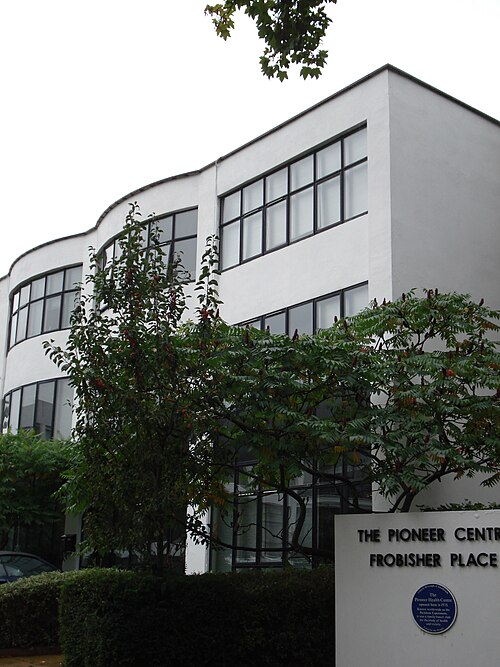
The ethological approach—observing behaviour in its natural setting—found physical form in the Pioneer Health Centre in Peckham, a building that Bauhaus director Walter Gropius famously dubbed an “oasis of glass in a desert of brick” in 1935.
Designed by Sir Owen Williams, this open architecture facilitated the “sight of action.” This was the hypothesis that health could be caught by observing others. The glass panels allowed biologists to observe the community without the white coat interference that defined traditional hospitals.
Charging a family subscription fee ensured the Pioneer Health Centre in Peckham remained a member-owned club, where health was nurtured through collective participation rather than top-down charity.
Collision with chemical triumphalism
This insistence on localism caused the experiment to collide with the new National Health Service (NHS) in 1948. Uncompromising critics, Williamson and Pearse famously branded it a “national sickness service.” They argued that the state’s focus on acute cures and chemical triumphalism (relying on new drugs like antibiotics) ignored the environmental roots of health.
The Ministry of Health dismissed the autonomous, fee-paying Centre as an ‘administrative irregularity.’ To a new top-down NHS built on hospital beds and pharmacy counters, a community club centred on a swimming pool simply did not compute as healthcare.
When the Centre closed in 1950, Britain abandoned a radical alternative for public health. Today, as we grapple with the limits of a purely curative system, the experiment’s core finding that health is a mutual synthesis of environment and organism feels strikingly modern. It serves as a reminder that health cannot be dispensed from a pharmacy; it must be nurtured within a community, from the ground up.
Jennifer Okerenta is a fourth-year medical student at the University of Manchester. She is a winner of a 2026 Norah Schuster Prize for her paper on which this blog is based. Her research explores the history of social biology, radical politics and the architecture of preventive medicine.
References and further reading
Armstrong, D., Political Anatomy of the Body: Medical Knowledge in Britain in the Twentieth Century. Cambridge: Cambridge University Press, 1983
Conford, P., ‘Smashed by the National Health’? A Closer Look at the Demise of the Pioneer Health Centre, Peckham. Medical History, 2016, Vol. 60, nr. 2, pp. 250-269
Conford, P., Anarchism and the welfare state: the Peckham Health Centre. History & Policy, 2024
Pearse, I. H. & Crocker, L. H., The Peckham Experiment: A study of the living structure of society. London: Allen & Unwin, 1943. Wellcome Collection.
Williamson, G. S. & Pearse, I. H., Science, Synthesis and Sanity. London: Collins, 1965. Wellcome Collection